


The ducal residence of Casimir Piast X and his family
CASTLE RESIDENCE FRYSTAT
Educational tour of the monuments of the Silesian Piast residence

Casimir Piast X., born in 1449 at the castle in Karviná - Fryštát, ruled in the years 1460-1477 as Prince of Fryštát, in the years 1477-1490 he ruled as Duke of Upper Silesia, and in the years 1490-1528 he ruled as Viceroy of Silesia. An entire generation of his Silesian subjects knew only him. They were born when he was already ruling and died when he was still ruling. During Casimir's Silesian rule, 5 monarchs succeeded each other on the Bohemian throne and 4 monarchs succeeded each other on the Polish throne. With a reign of 63-68 years, this "eternal duke" ranks among the longest-reigning monarchs in the world. When he began to rule, he took over the politically fragmented and disunited, and economically unstable Silesian land. However, his harsh rule led to the unification of Silesia, its prosperity and well-being, development, peace and tranquility. When he died in 1528, he left behind Silesia a politically united, religiously very strong and economically the most advanced and richest country in Central Europe.


start - UNDER THE CASTLE


Casimir's mother, the Silesian Duchess Anna Piast, founded Podzámčí (Under the Castle) around 1470 and became the patron saint of Fryštát.

The trip across the historic Fryštát begins at the parking lot under its castle. Here we are in the Podzámčí, or Lower Suburbs, which was founded around 1470 by the Silesian Duchess Anna Piastovna for the poor inhabitants of Fryštát. In fact, it was just a relocation of the original poor district of Miserov, which was located on the site of today's Silesian University. Duchess Anna was the loving and beloved mother of the Silesian Viceroy Casimir Piast X., who was born here in the Fryštát residence in 1449 and grew up here in luxurious royal conditions, was educated and raised by his mother. Duchess Anna instilled in him a love for ordinary people, was a great example for him in this, and Casimir supported her in her charitable activities and, during his absence, entrusted her with the government as duchess-mother. From her own resources, the Duchess financed the operation of the Church of St. Bartholomew, which she built here in Podzámčí (it was demolished in 1683). Duchess Anna also gave poor residents of Podzámčí work for the ducal court. For example, women from Podzámčí washed and bleached linen and clothes for the ducal family and the castle courtiers, and soon after, they also received laundry to be washed from the Fryštát nobles and wealthier townspeople. They also took care of the ducal vegetable garden and orchard, which were located here on the site of today's Castle Park. The park was primarily a ducal hunting ground, so when the Silesian Duke and his nobles hunted game here, the poor residents of Podzámčí were always on hand to help. Men from Podzámčí worked at the castle as armor bearers and guards. They were also hired by the duke as mercenaries in wars, where in addition to wages they could also receive a share of the spoils, or they were also hired as workers on construction sites. The children of the castle, of which there were enough in every house, found employment as helpers in the church or on the pastures. Older girls served in the castle as maids and when their service ended, they could find a job as housekeepers for a nobleman or a richer burgher, because they had experience from the ducal court and this was considered prestigious. The young men worked as helpers in the ducal stables of Lottyhaus, in the ducal forests or on the ducal ponds. The poor class of Fryštát earned money in this way at least for basic needs, and the poor Podzámčí prospered quite well. But the really poorest inhabitants of Podzámčí were accommodated by Duchess Anna in the almshouse of St. Andrew, which she also built here. In the almshouse, Duchess Anna employed other poor residents from Podzámčí, who took care of its operation. Among other things, their job was to deliver leftovers from the ducal table, so that the poorest people could paradoxically at least taste some of the selected delicacies that were served on the ducal table of Fryštát Castle (the St. Andrew's almshouse was demolished in 1683 and was replaced by the hospital building of today's Czech Post Office near the castle). With these noble deeds, the Silesian Duchess Anna Piastovna became the patroness of historical Fryštát.


Let's now walk through the ducal Fryštát in the footsteps of the Silesian rulers from the ducal Piast dynasty, who resided here from 1282 to 1571. During their 300-year stay in Fryštát, they built several monuments that are still preserved today, and behind each of them are beautiful stories from behind the scenes of the ducal court, which were kept secret for many centuries. I, the castle court preceptor, but today I am just a retired Fryštát knight Wenceslas, will accompany you on the way. At each stop, I have an interesting story prepared for you.
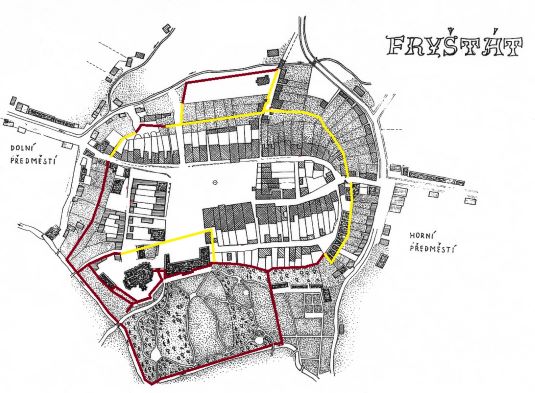
Now, according to the map, we will go past the castle church, across the edge of the park along the walls to the castle, to point no. 1. "WALLS" and stop in front of the Castle Gate at the corner of the castle.

1 - WALLS

Casimir's great-grandfather, the Silesian Duke Piast VII. Přemysl, established a large castle guard in Fryštát around 1370

If you stand in front of the Castle Gate at the corner of the castle, in the place as shown in the opening photo of this stop (and then also at every other stop), then you are standing at the most visible monument of the medieval Fryštát defense system. The monumental wall under the church was built only in the second half of the 18th century by Count Taaf because of the receding slope, but this new wall fully replaces the original Gothic-Renaissance walls that were there. In 1821, the Larisch-Mönnich family tomb was added to this wall, where the first members of this family are still buried today. The first Fryštát walls surrounded only a hunting lodge built around 1282. The Silesian Duke Mičislav Piast V. built a moat around the castle, complete with a rampart and a fortress wall. The moats were first fed by the Dubina stream, which flowed around the castle until 1511 - 1514, but then it was replaced on the southern side by the artificial Mill Drive, which still exists today. Before 1376, the Silesian Duke Přemysl Piast VII. carried out a Gothic reconstruction of the Fryštát hunting castle into his second residential residence. He gave the Fryštát castle more defensive elements in the form of a tower with an embrasure, corner defensive terraces, and also repaired the original moat, on the bank of which there was a high rampart supplemented by a wall. On the slope below the church, he built a new defensive wall with embrasures, the remains of which are still preserved today, and which the attackers had to charge and climb over in the event of a siege of Fryštát. However, behind this wall, Fryštát's soldiers and mercenaries were already waiting for them. They overturned their ladders, poured hot water and hot oil on them and shot arrows at them. For example, Fryštát and other Silesian towns faced such an attack by the Hussites in 1427-1428 during the reign of Přemyslav's son, Duke Bolesław Piast VIII. The Hussites more or less plundered the Silesian towns. Some towns were burned down, some defended themselves. In addition to the Silesian army, civilian men and old people, as well as women and children, also joined the fight against the Hussites. The Hussites were killed and their bodies were thrown into ditches and wells. Duke Přemysl also repaired the fortress wall around the entire residential castle town of Fryštát. Their last visible traces can be seen under the Zámecká and Pivovarská streets and also near the Svatováclavská street. However, even after these repairs, Fryštát did not have strong walls, so Duke Přemysl reinforced the castle military detachment here to defend Fryštát and guard its streets. However, the residential town was primarily protected by a ring of surrounding ducal defensive castles in Frýdek-Místek, Silesian Ostrava, Racibórz, Bytom, Bielsko-Biala and in Cieszyn. However, the Fryštát fortifications underwent regular renovations, first in 1525 during the reign of the Silesian Viceroy Casimir Piast X and then in 1683 and 1805, each time Europe was threatened by raids by the Ottoman Empire. They were dismantled during the Larisch-Mönnich era and only at the end of the 19th century.


Fryštát Military Detachment
In the Middle Ages, the Fryštát castle guard constantly patrolled around the Fryštát walls, at the gates, on the towers and in the alleys. They had their posts in the armories on both southern corners of the castle, where they took turns on duty and ate, drank, had fun, rested and slept during their free time. Their duty was also to take care of the armor and keep it in readiness. They had swords, fangs, spears, sabers and axes, as well as striking weapons such as flails, maces, maces and hammers. The armorers also kept their personal shields, helmets, chest armor, chain mail, quilts and plate armor in the armories. The duties of the Fryštát armorers also included guarding the prisoners in the castle prison. The small window above the ground just in front of the Castle Gate belongs to this prison cell and above it was the armory. In addition to the pawns, the innkeepers of Fryštát were also imprisoned here for violating the law that forbade them to serve guests beer other than that from the Fryštát Castle Brewery. Certainly the most famous prisoner that the Fryštát armorers guarded in the cell was Baron Kaspar Wilczek, the great-grandfather of the current Prince of Liechtenstein, who was imprisoned here by His Grace, the Silesian Duke Frederick Casimir Piast XIII, for unauthorized possession of the mile rights of the Silesian town of Bílsk (today Bielsko-Biala in Polish Silesia). He was imprisoned in March 1563, the trial lasted 4 months, but the baron extended his stay in the Fryštát prison to 22 months because he did not want to return what he had appropriated. The service of the Fryštát squires was not easy and was 24 hours long, but since most of them lived in Fryštát and the surrounding area, they could ask the Burgrave for leave and spend some time at home with their families. However, when the trumpeters on the towers sounded the alarm, all the squires immediately went to their posts to prepare for a possible enemy attack. The Fryštát squires in the service of Her Graces the Silesian Dukes were professionals paid for their work. The best-paid soldiers were horsemen, the least-paid were foot soldiers. However, His Grace the Silesian Duke often hired mercenaries for wars and for the defense of the Fryštát castle, who were mostly people from the poorer classes, who in addition to their wages could also receive a share of the war booty. The mercenaries were paid from a tax that was paid by the wealthier townspeople to buy themselves out of participating in the wars. Sometimes, the Fryštát master craftsmen sent their journeymen and apprentices to the wars on their behalf. However, they all received weapons from the castle armories.
According to the map, you can reach stop number 2 "KITCHEN" by passing through the Castle Gate and stopping at the statue of St. Patrick.
2 - KITCHEN

Casimir's grandmother, Silesian Duchess Euphemia II Piast, establishes royal relations in Fryštát in 1431

If you stand by the statue of St. Patrick facing the Castle Gate,which was built by Count Larisch-Mönnich at the turn of the 18th and 19th centuries, there is an inconspicuous castle wing on your left. The chimney will tell you that this is the castle kitchen. Before 1420, Duchess Euphemia II. embarked on a major reconstruction of the Fryštát hunting lodge, where she permanently moved the Silesian ducal court after her widowhood in 1431, and built this kitchen wing, which became the basis of royal court etiquette at Fryštát Castle. The master of the Fryštát castle kitchen was the duchess' court chef and his assistants. He supervised the storage, preparation and portioning of food, while the final preparation, serving and delivery of food from the kitchen to the banquet hall were in charge of the butlers, waiters and slicers. Everything the ducal family liked was cooked here, only pastries were bought in the Fryštát bakeries, because its production was quite time-consuming. The original black kitchen was built with the founding of the hunting lodge around 1282 by the Silesian duke Mečislav III. Piast and still stands in the southeastern part of the castle. However, the new Fryštát castle kitchen wing fully replaced it. It was very modern for that time and only the richest could afford its construction and operation. It was built in the immediate vicinity of the banquet hall, so the delivery of food from the kitchen to the ducal table was very convenient and fast. The served food did not cool down before it was brought to the estate's table. Food, wine and beer were stored in the cellars of the kitchen. A well has been preserved there to this day. It not only supplied water to the kitchen, but also satisfied the needs of everyone in the castle. Its location here was very convenient. The fact that it was located in the basement of the Kitchen Wing made it easier for the cooks to deliver water to the kitchen. The single-room kitchen itself (today the Castle Gallery - III. Castle Tour Route), located on the ground floor, also had a cutting room and a preparation room, and the cooks were just bustling around here. The first floor of the kitchen belonged to the castle staff, who prepared the food here for the final touches and only when the food was ceremonially served did the pages take it from here to the banquet hall. The kitchen wing served its purpose until the time of the Larisch-Mönnichs, who lived here until 1945. The Castle Gallery is now located in the kitchen area.
SILENCIAN CUISINE is popular in Central Europe. Who wouldn't know potato salad, potato dumplings and potato pancakes. Potatoes were introduced to the common people by the Irish family of Count Niklas Taafe von Carlingford, who lived in Fryštát in the 18th century. Thanks to him, potatoes, which had previously been a crop of aristocrats, became a popular dish. Typical Silesian dishes include poppy seed strudel, fried cottage cheese sandwiches and meatballs. However, the most characteristic feature of Silesian cuisine is meat always accompanied by fruit. Whether the meat is cooked directly with fresh or dried fruit or the finished meat is accompanied by fruit compote, this combination is mandatory for Silesian cuisine. From the mid-15th century, Bigos - a stew made of two meats, two cabbages and sausage, which came here from the Jagiellonian royal kitchen, was also served on the Fryštát ducal table, but in Silesia it was cooked... with nothing but plums
.


Fryštát pages and the feast of the princes
The ducal table in Fryštát was mainly served with meat. The daily consumption of meat here was half a kilogram per person, mainly beef and pork, less often mutton. However, poultry was served much more often, especially hens, roosters and capons, chickens, ducks and geese. Game was also prepared for ceremonial events, from the mid-16th century from the Duke's own breeding in the Duke's hunting ground in the Loucký Forest in Karviná. The meat was eaten with white or dark bread and washed down with wine or beer from the Fryštát brewery. We used spoons and a skewering knife for cutlery, but we ate more with our hands. Various soups and sauces were also served in bowls. Exotic fruits such as oranges, figs, pomegranates and citrus fruits also made their way to the ducal table. And on the days of fasting, which there were about 192 in the year, fish or legumes prevailed. If the feast was large and festive, the service staff was supplemented by pages who helped with the delivery and serving of food. It was not permissible for the Silesian monarchs to wait for their food and drink. The wishes of all the feasters had to be fulfilled immediately, perhaps even before they were expressed, so the local staff was constantly on the alert. The food served was always more than enough, because if any of the dishes ran out, it was a great disgrace for the Silesian ducal court in Fryštát and the conditions built by the duchess could suffer immensely. Her Grace the Silesian Duchess Anna also introduced a rule here that the excess food that was not eaten was distributed as alms to the poor from Under of the Castle. During the festive feast, music always played here and jugglers performed with her. You can dance a Gothic dance from the 15th century by clicking on the YouTube link.
According to the map, you can reach stop number 3 "WHITE TOWER" by walking past the Castle Chapel and stopping under the White Tower.
3 - WHITE TOWER AND CHAPEL

Casimir Piast X., Duke of Silesia and Viceroy, builds the White Tower of the castle in 1515

Now stand under the White Tower. Theparish courtyard under the tower acquired its current form in the 18th century thanks to the Taafe family of counts. However, the Castle Church of the Exaltation of the Holy Cross is 500 years older, and until 1945 it was part of the castle and owned by the Silesian aristocracy. It was built by the Silesian Duke Mečislav Piast V around 1282, initially as a simple castle chapel of the Virgin Mary, which was part of the Fryštát hunting castle. And since it was customary for the Piasts to also serve the townspeople, shortly after its construction it had to be equipped with a wooden floor inside to accommodate more people. It was not until around 1370 that the Castle Chapel was expanded by the Silesian Duke Přemysl Piast VII. The Duke added the South Chapel to the Castle Chapel, under which he also built an underground crypt for the burial of Fryštát clergy, and perhaps the Silesian dukes residing in Fryštát were also buried here. The area around the chapel was designated as a burial place for important residents of Fryštát, especially Silesian nobles. The Duke also built a tall wooden tower with a bell tower here, the stone foundations of which are preserved at the southern foot of the parish building. The crypt is empty today, but the Larisch-Mönnichs are buried in the family tomb from 1821 next to it. In 1420, Duchess Euphemia II. Piast expanded the Castle Chapel again and added the North Chapel. The Castle Church thus received a Latin cross layout and had a magnificent cathedral appearance. The present-day appearance of the castle church is, however, the work of the Silesian Viceroy Casimir Piast X. In the years 1511 - 1514, he carried out a major Renaissance reconstruction of the residential castle and in 1515 began the construction of the White Tower, which replaced the existing wooden Gothic bell tower. The original Gothic wooden tower was replaced by the White Tower by chance. The Silesian Viceroy Casimir was very friendly with the Polish king Sigmund I Jagiellon, to whom Casimir was the elder godbrother. They often visited each other both in Krakow and in Fryštát, where they fished together in the Loucké ponds, hunted game in the hunting ground below the castle, but most importantly - they had noisy fun and drank. Once, in a drunken state, King Sigmund destroyed the equipment of the Banquet Hall of the Fryštát castle, but after sobering up, he fully reimbursed Casimir for the damage caused. Another time, on a state visit to a foreign court, the king ate rare bison meat, secretly hid some meat and sent it to Fryštát by his servants so that Casimir could also taste the bison meat. Just for fun. However, on the night of April 16-17, 1511, both monarchs were so wild here in the castle that in the early morning, around 3 a.m., they set the Banquet Hall on fire while drunk. The fire quickly spread throughout the castle and eventually the entire city was engulfed in flames. So that same year, Casimir began a comprehensive Renaissance reconstruction of the Gothic castle and built a new one, the White Tower. At first, the tower was only about half as high, but after Casimir's death in 1528, the tower was raised to its current height. In the interior of the tower, you can see where the tower was being built from. Legend has it that during the completion of the tower, a worker fell from its superstructure, but he immediately got up and returned to his workplace limping. His limp disappeared at that moment. The place on the eastern side of the tower from where he fell was previously marked by his knee in the form of a small hemisphere. Be sure to visit the castle church and the tower, they are also surrounded by legends about the Miraculous Bell from the time of Casimir's daughter-in-law, the Silesian Duchess Anna Piastovna Hohenzollern, who ruled in 1528-1539, and about the Miraculous Image of the Virgin Mary of Fryštát from the 17th century, which is located in the South Chapel. Above all, visit the castle's North Chapel, where you can see the Renaissance epitaph of the Fryštát knight Wenceslas of Slupsk and Fryštát from 1577, which will accompany you through Fryštát. In this North Chapel, you will also still find some original Gothic elements, the entrance portal to the lower chambers of the White Tower, and there are also Gothic frescoes dating from the reign of the Silesian Duchess Anna Piast of Bielsko, mother of the Silesian Viceroy Casimir. In the 19th century, the Larisch-Mönnichs renovated the interiors of the Castle Church in Baroque style, which resulted in the disappearance of the beautiful Gothic architecture that the Piasts had developed here for 300 years. You can see a similar example of this original Silesian Gothic by visiting the castle chapel in Racibórz, which is the twin of the original castle chapel in Fryštát. The rectory building in front of the church stands on the original Gothic-Renaissance foundations from the time of the Silesian Viceroy Casimir, but was rebuilt into its current form in the 18th century by Count Taaf. The adjacent Renaissance Parish Courtyard with originally parish residential buildings dates back to the 16th century, from the time of Casimir's Renaissance reconstruction of the castle. After this reconstruction, the White Tower became the main dominant of the castle and the entire Fryštát residence. However, few people know that the White Tower also depicts the local White Lady of Fryštát.


On September 3, 1569, between 9 and 10 p.m., the young, beautiful Silesian duchess Catherine Piast, a beloved and loving wife and mother, died at Fryštát Castle. She was the last Silesian queen in Fryštát, and today we know her as the White Lady of Fryštát, the patron saint of all lovers in Fryštát. The last days of her short life are associated with the White Tower. Come and lay a flower by the tower in memory of this Silesian queen, who is buried here.

White Lady of Fryštát
Her Grace Silesian Duchess Catherine Piast, from the Legnica dynasty, was affected by the White Plague and her husband, His Grace Silesian Duke Frederick Casimir Piast XIII, had to quarantine her in the lower chambers of the White Tower. Despite all the care of the healers, the Duchess died here in 1569 and His Grace Duke Frederick Casimir buried her here in the Castle Church. During the entire time the Duchess was in the White Tower, the bells in the tower were not allowed to ring and the Duke visited her in the tower chambers every day with the little princess Catherine, even though they risked passing her disease on to themselves. That's how much the ducal family loved each other. Duchess Catherine was a beloved and very loving woman by all. She became the patron saint of all couples in love in Fryštát. Since Her Grace Duchess Catherine died here, we have begun to consider the tower as the White Lady of the Fryštát castle, because the tower reminded us of the figure of the terminally ill duchess, dressed in the white dress with black buttons that she wore, with a high dark cap on her head and with her beautiful big black eyes, lovingly embracing her daughter, Princess Catherine. Look at the tower from below and admit for yourself that with a little imagination, the White Tower with the lower turret can really look like this... The bells rang for the first time after several weeks of silence on the day when Her Grace Duchess Catherine died here. It was September 3, 1569 between 9 and 10 p.m. People gathered at the tower to pay homage to Her Grace Duchess Catherine and express their sorrow over her death. The whole of Silesia has also fallen into mourning because Her Grace the Silesian monarch has passed away. By placing a bouquet at the tower, you will support the memory of Duchess Catherine, the White Lady of Fryštát, as the Patron Saint of all lovers. Thank you very much.
According to the map, you can reach stop number 4 "PIVOVAR" by walking down Pivovarská street and stopping at the Pivovar courtyard.
4 - BREWERY

Casimir's father, Silesian Duke Piast IX. Boleslav, founded a princely brewery in Fryštát in 1447

You are in the neo-Gothic courtyard of the Fryštát Castle Brewery. It was founded in 1447 by the Silesian Duke Boleslav II. Piast. In the same year, he also elevated his residence Fryštát above other Silesian towns and continued the close family ties of his mother, Duchess Euphemia II. with the royal Jagiellonian dynasty. The Castle Brewery was actually a cooperative brewery, in which a large Fryštát aristocracy had a stake. Duke Boleslav II. placed the brewery's headquarters in the building of today's extended part of the Town Hall, which we will visit later, and it was moved to this location in Pivovarská street at the beginning of the 16th century by Boleslav's son, the Silesian Viceroy Casimir II. The oldest surviving building of the Duke's Brewery here in Pivovarská street is its Renaissance malt house from the early 16th century, where today there is a legendary, medieval tavern called "Na Bečkách", where you are invited to refresh yourself with delicious Fryštát beer.


Operation of the Fryštát brewery
The local castle beer was drunk in large quantities by the townspeople of Fryštát, but it was also supplied to the ducal table and enjoyed by the famous royal processions that spent the night in Fryštát on the way between Vienna, Prague, Krakow and Saxony. Opposite the brewery, there is still a brewery stable that was used by the Duchess of Saxe-Lauenburg in the second half of the 16th century during her stays in her private palace in Fryštát. Under Fryštát there is a network of unexplored underground passages, often connecting the cellars of the townspeople's houses, through which the material for beer production flowed. There was a well under the Town Hall, here in Pivovarská Street there was a malthouse, but the actual brewing of beer took place in the cellars of the licensed brewing houses, of which there were 80 in Fryštát in the 15th century and 90 in the 16th century. This production cycle was interrupted only by the Thirty Years' War after 1642. Most of the breweries were destroyed during this war, so only 4 have survived to this day. Two houses with taverns are in the Castle Courtyard by the fountain, one is opposite the entrance to the Town Hall and one is in the Pre-Castle, where a knight's tavern has been operating since 1564. The breweries were also the rectory, which has survived to this day, the aforementioned palace of the Duchess of Saxe-Lauenburg, and the northern part of the Lottyhaus, which until 1823 was two separate burgher houses, connected to the Lottyhaus only in that year. The other burgher houses today stand on the medieval foundations of the breweries and also have preserved cellar rooms that formed the brewery corridors.
According to the map, you can reach stop number 5 "NÁDVOŘÍ" by walking to the end of Pivovarská street, turning right and stopping at the corner house with the sign KNIHOVNA.
5 - COURTYARD

Casimir's Fryštát Castle Courtyard welcomes royal processions at the turn of the 15th and 16th centuries

Stop at the Palace of the Black Princess Sidonia with the inscription LIBRARY (KNIHOVNA) and look around the courtyard. The Castle Courtyard in Karviná-Fryštát is one of the most beautiful historical places in Silesia. It is dominated by two Piast towers: the older White Tower of the bell tower and the younger Town Hall tower. The current Renaissance appearance of the Castle Courtyard was created in 1511-1514 and was a revolutionary innovation at the time. Never before had a ducal castle in Silesia been connected to the city without walls like this. The new courtyard was beautiful and very spectacular and soon gained the reputation of a place you must see. To this day, you will not find anything like it anywhere else in Silesia. Spectacular ducal and royal processions gathered in the new Castle Courtyard and many famous knightly tournaments were held here. Silesian Viceroy Casimir Piast X, who built this Castle Courtyard, immediately used it for his ostentatious representation. He convened important meetings here and also organized large banquets here. However, central Fryštát, where we are located, was already established from the end of the 13th century as a town square where markets were held, and was the only Fryštát district that was surrounded by walls. Before 1511, the original Gothic square was separated from the castle by a row of burgher houses and castle walls with a moat, similar to what we can still see in the Silesian town of Hlučín. The Dubina stream flowed through the middle of the square, which also fed the castle moat. In 1454, the royal wedding procession of Queen Elizabeth of Austria arrived at the original Gothic Fryštát Castle Courtyard, separated from the square, and spent the night in Fryštát, so that the next day her procession could continue on its journey to Krakow, Poland, where she married King Casimir IV. Jagiellon. Their son, the young prince Vladislav II. Jagiellon, rode through Fryštát in 1471 in his magnificent and famous coronation procession. The procession was led by the young Silesian Viceroy, then Prince Casimir Piast X. of Fryštát, and he hosted King Vladislav for a few days at his Fryštát Castle. Casimir entertained Vladislav with knightly tournaments, hunting expeditions and festive feasts. Easter markets have been held in Fryštát since 1473. During these markets, which were also founded by the Silesian Viceroy Casimir, Fryštát Square was very busy. Sellers and buyers shouted loudly at each other with their goods, poultry and small livestock ran around, and jugglers and musicians provided a cultural highlight. There was no shortage of paws here either, which is why the castle guard, who also served as the medieval city police in Fryštát, was constantly patrolling the square. The Gothic Fryštát Square underwent a major Renaissance reconstruction between 1511 and 1514, when the Silesian Viceroy Casimir carried out a Renaissance reconstruction of his Gothic residential castle. Casimir demolished the castle's northern fortifications with moats and bought the houses that stood between the castle and the square from the townspeople. The castle thus opened up to the square, creating the large Castle Courtyard that you can still see after 500 years. The richest townspeople and Silesian nobles lived in the houses and palaces in the new Castle Courtyard, as well as the castle courtiers and court officials who were constantly at the service of the dukes in the castle. The New Castle Courtyard also immediately became the center of events. Festivals, other markets, knightly tournaments were held here and other royal processions stopped here. The largest of these royal processions arrived in the Castle Courtyard in 1543. The Polish king Sigismund II. Jagiellon brought his new wife Elizabeth of Habsburg to Fryštát, who rode from Vienna to Krakow in a large gilded carriage, accompanied by his court ladies and a white-clad horse cavalry, consisting of noble nobles and clergy, as well as an army of soldiers and squires, numerous servants and a field kitchen. From Vienna, the queen traveled through Olomouc, where she spent the night, and where another procession headed to Krakow joined her. In the end, there were 1,500 of them in total. When the main part of this procession arrived at the Fryštát Castle Courtyard, everything was already ready for the queen and her entourage to stay. All the upper rooms of the castle were turned into dining rooms, and those who could not get in took over the surrounding townspeople's houses. Just imagine the great hustle and bustle in the castle corridors, where the retinue of pages carried mountains of food and drink to all the chambers, and what a huge job the cooks and the castle Hofmeister, who supervised everything, did. Throughout the feast at the Fryštát Castle, musicians played and the queen was entertained by jugglers. The Fryštát Stallmaster stabled the most precious horses of the royal procession in the ducal stables in the Lottyhaus, which you can see on the southeast front of the courtyard right opposite the castle. The other horses had to be left standing by the stall-master in the meadow below the castle. There were also many tents where the royal soldiers and servants spent the night. However, an endless number of curious people also came to Fryštát, who wanted to see the queen and her huge gilded carriage and the magnificent procession. Many merchants also came to sell their goods here, and jugglers who also wanted to entertain the queen and her entourage. People were having fun everywhere, dancing and singing. When the queen was leaving, in front of the castle She got into her gilded carriage and the entire procession set off on its final leg to Krakow. At the Royal Castle in Auschwitz, the envoy of the Polish King and his entourage were waiting for the Queen, who then accompanied the Queen to the Royal Castle of Wawel.
In the Castle Courtyard, don't forget to take a picture with the beautiful Vienna Fountain from 1900, which stands on the site of the original medieval one from 1543, and also visit the Municipal Gallery located in one of the burgher houses on the northern front of the courtyard. Near the fountain were meat bridges from the times of medieval markets, the remains of which are still preserved under the paving stones.


Royal processions in Fryštát between 1454 and 1553:


Black Princess of Fryštát
One of the formerly magnificent palaces in the Castle Courtyard is a Gothic-Renaissance palace with an adjacent stable building, which today houses an exhibition hall and a library, which you are standing near. In 1568, the palace was given as a wedding gift to the Saxon Duchess Sidonia of Saxe-Lauenburg, after she married Duke Wenceslas Adam Piast XII in Silesia. The Duchess arrived in Fryštát with a 300-member procession, where she was welcomed in front of the castle by the Silesian Duke Frederick Casimir Piast XIII. He sat on a horse dressed in Upper Silesian blue and gold colors and had a large yellow crest on his head. In front of the castle, he and the Silesian Duchess Catherine presented her with a large French gold chain. Duchess Sidonia enjoyed staying in her new Fryštát Palace, especially after her widowhood in 1579. She walked around the Fryštát Courtyard dressed exclusively in black, which earned her the nickname the Black Princess. The Duchess loved children, she gave birth to five of them herself, but two of them died shortly after birth. Out of compassion for sick children, she became their patron saint, because a plague epidemic was spreading in Silesia at that time. Duchess Sidonia visited hospitals throughout the Duchy of Silesia, where she comforted sick and suffering children. She always brought them something good and tried to help them with her knowledge of natural medicine. Although the Duchess later married into the Hungarians, she did so until her death in 1594. In the 19th century, the Fryštát Palace of Duchess Sidonia served as the seat of the Larisch-Mönnich Castle Majordom, and its stables housed the most precious Larisch-Mönnich horses. Today, you can visit the palace and see one of the exhibitions in its beautiful Gothic-Renaissance rooms.
According to the map, you can get to stop number 6 "RADNICE" by walking to the other side of the courtyard and stopping at the corner of the Town Hall by the tower
6 - TOWN HALL WITH THE PIAST TOWER

Silesian Viceroy Piast X. Casimir, changed the Fryštát tavern into the Town Hall in 1504 and in 1563 his great-grandson Duke Piast XIII. Frederick Casimir built a tower here

Stand on the corner of the Town Hall by the tower. The place with the oldest settlementof the Fryštát castle town is the local Golden Alley, with the postal name Fryštátská, but for many centuries correctly called Radniční. Somewhere in Fryštát, it is unknown where, since the 14th century there was a wooden house where the aldermen and the Mayor met to resolve city affairs and exercise judicial power. They also supervised the order in the streets, the safety of the inhabitants, regulated the operation of horse-drawn carriages in the city and, among other matters, organized annual and city markets. However, in 1505, the Fryštát city council finally moved to its new Town Hall building, which you have in front of you. Originally, this building of the Town Hall was a tavern from the 14th - 15th centuries. In 1504, the Silesian Viceroy Casimir Piast X bought this tavern from the innkeeper Jožek Šlosar and sold it to the city councilors for half the price to establish a town hall. This noble act of Casimir is recorded in the purchase deed, which is still preserved in the Museum of the Silesian Provincial Archives in Karviná. After the reconstruction in 1505, the building was ceremonially opened as the Town Hall and serves as the seat of the Karviná mayor to this day. In the 16th century, the Fryštát city council consisted of one Mayor and three aldermen, who were elected annually by the duke. One of the Mayor was the Silesian nobleman Wolf Izajáš of Střítež, who lived with his family in his house in Fryštát. He was born around 1510 at the Střítež Castle of his parents, the lords of Střítež. Between 1520 and 1529, his father died and the young Wolf inherited the village of Střítež with all its estates from his widowed mother Barbora Střítežská, who remarried the nobleman Jiří of Staré Město u Fryštát. Like his grandfather and father, Wolf also served at the ducal court. In 1545, for his faithful services, he received a gift from Duke Wenceslas Adam Piast XII. a house with a garden that stood in the Solca suburb in front of Fryštát, and where Wolf Střítežský lived until his death in 1565. Sometime between 1545 and 1565, Wolf was elected Mayor of the Silesian residential town of Fryštát by Duke Wenceslas Adam Piast XII., or Duke Frederick Casimir Piast XIII. During Wolf's mandate, Fryštát was a very prosperous Silesian residential town. Its products were exported to all of Europe. After Wolf's death, the remaining Fryštát estates, including the estates in the Old Town with 11 ponds, which Wolf inherited from his stepfather Jiří, were then purchased from Wolf's widow in 1565 by Duke Frederick Casimir Piast XIII. for 475,- Zlaty. The Mayor of the town of Fryštát, accompanied by their aldermen, regularly attended ducal audiences at the castle, where they also made their demands to the duke. On July 29, 1549, at such an audience, the Mayor with Duke Wenceslas Adam Piast XII. resolved the dispute that the residential town of Fryštát had with the ducal knight George Pillar of Pilla regarding the town land bordering on George's land, which the knight George had illegally occupied. For this illegal act, the knight George lost his knightly spurs, which led to his great disgrace. On March 15, 1569, another Mayor requested from Duke Frederick Casimir Piast XIII. confirmation of the town's privileges regarding the tapping of beer and the breaking of stone, and on April 25 of the same year, during the ducal audience, the Mayor requested confirmation of all previously issued significant privileges to the town. However, for such confirmations, the Mayor had to pay the duke a large sum of money from the city treasury. However, this paid off for the town, because it prospered greatly from the presence of the ducal court in Fryštát. The treasury in the form of a chest has survived to this day and is kept in the depository of the Museum of the Těšín Region. Originally, the Town Hall had its own tower, which seemed to peek out from the courtyard. In 1564, a new tall tower with a clock and a gallery under the battlements was added to the Town Hall. On the top floor of the tower was the room of the city watchman, who supervised the security in the city from above, while the ground floor room used to be the guardhouse, where the city police officers who supervised the order in the city worked. The watchman from the upper floor of the tower notified the police officers on the ground floor where something unfair was happening in the city, and the police officers immediately went there to restore order. The Piast Town Hall Tower also contains the remains of the medieval pillory chain of the painful law, to which sinners were tied for public shame. Thieves or unfaithful women were tied here for public lynching, and passers-by spat on them and threw rotten vegetables and eggs at them. The windows to the left of the entrance to the Town Hall are the windows of the original Šlosar tavern from the 14th/15th century, but from the 16th century there was a torture chamber with the necessary torture devices, "so that a stubbornly denying criminal could be forced to confess by torture, and if necessary the torture was repeated several times." The torture chamber also kept weapons such as halberds, spears, pikes and muskets. The city executioner kept a 1.5m long sword here for carrying out executions. When the offender was taken out for public execution, the "Death Note" bell rang on the tower the entire time. This bell was later transferred to the Sanctus tower of the Castle Church. The city executioner, in the presence of the city council, conducted interrogations using gruesome methods. We have one older case recorded from January 1406: "In front of a large crowd, the Silesian Duke Přemysl Piast VII. ordered the murderer to be loaded into a copper basket for burning coal, and with hot coals inside, he was carried through all the streets and suburbs of the city. Then the executioner tore his body piece by piece with hot tongs and finally tore out his entrails. After many of the most complex tortures, the murderer gave up his spirit." Today, the Mayor of Karviná meets with city representatives in the former torture chamber. In 1605, on the centennial anniversary of the opening of the Town Hall, the Mayor of Fryštát unveiled the Fryštát coat of arms with the year 1605 above its entrance, over which the crowned head of the Silesian Viceroy Casimir Piast X watches.

The Last Knight of Fryštát
In the spring of 1564, surrounded by nobles, courtiers, clergy and city councilors, here the Duke of Upper Silesia Frederick Casimir Piast XIII welcomed his new wife, Duchess of Lower Silesia Catherine Piast. In honor of the introduction of Duchess Catherine to her new ducal residence, here under the Piast Town Hall Tower, the Duke of Silesia Frederick Casimir organized alarge knightly tournament and himself happily participated in it. A wooden tribune was built on the square under the tower for the noble estate and the audience consisted of the townspeople and common people, often from a great distance. Knightly tournaments were a renowned "sporting" event in Fryštát, and for the Fryštát audience, the meaning of entertainment was that they sought it as a means of relaxation and distraction after hard work. The participating Silesian knights strove for prizes and competed for the favor of the ladies watching. The aim of the duel was not to kill the opponent, but to throw him off his horse and capture him. The knights' tournament had its trumpeters who gave the signal for the start of the fight. Individual jousts evoked strong emotions in the audience and the knights themselves were encouraged by them to perform feats for which they wanted to be celebrated. In addition to the financial reward, the winner also received the opponent's armor and horse. He also received the opponent himself, for whom he then demanded a ransom. The higher the nobility of the defeated knight, the higher the ransom the winner demanded. This was also part of the ceremonial games in Fryštát. The Piast Town Hall Tower became the main dominant feature of this wedding knights' tournament in Fryštát. This new tower is still adorned with the coat of arms of the Silesian ducal family of Piast, which was the highest Silesian aristocracy and the only Silesian ruling dynasty, and embodies Frederick's regal ambitions as the last knight of Fryštát - the Silesian Duke of Fryštát. The Duke wanted to restore the formerly famous seat of power in Fryštát, and behind this he also built his new, ostentatious residence - Ráj Castle - on the outskirts of the city. He also united both Silesian ducal families by marrying the Lower Silesian Duchess Catherine. Their happy marriage produced Princess Catherine, but within a short time this last Silesian ducal family in Fryštát died of the plague. Already seriously ill, Duke Frederick Casimir was forced by Emperor Maximilian II of Habsburg to travel to Prague Castle, but the Duke did not survive this difficult journey. He died on May 4, 1571, near Pardubice, where he is buried, and where his body is still waiting to be transported to his home town of Fryštát. In Fryštát, the duke is still remembered primarily by his famous Piast Tower.


In 1574, the French King Henry III stayed at the Fryštát Town Hall Inn
The courtyard is part of the extended part of the Town Hall, which has been the seat of the Duke's Castle Brewery since 1447, founded by Casimir's father, the Silesian Duke Boleslav Piast IX. From the courtyard, you can see how the original Town Hall tower, which was adjacent to the rear wing of the Town Hall between 1505 and 1564, has been lowered. In the basement of the extended part of the Town Hall, there is a well from which water was pumped for brewing beer and distributed through underground corridors to the houses with the right to brew beer, of which there were 80 to 90 in Fryštát. After 1504, the seat of the Duke's brewery was moved to Brewery Alley, and an inn, or medieval hotel, was built in the building of the extended part of the Town Hall, where knights and other visitors to Fryštát stayed. There is still a restaurant on the ground floor, continuing the tradition of this inn, and the floor where the hotel rooms were located houses the Town Hall offices. Visit this medieval inn for lunch and while you feast, learn about the story of the French king Henry III of Valois, who also feasted and stayed here.


King Henry III of Valois spends the night in the Fryštát Town Hall Inn
The Town Hall Inn is associated with the infamous act of the French King Henry III of Valois. In June 1574, he and his entourage stayed at the Town Hall Inn while fleeing from Krakow to Paris. In 1573, Henry III was elected King of Poland, but he was notwell-liked in Poland. Therefore, when his brother, King Charles IX, died in France in 1574, Henry became the successor king of France. In Krakow, he took advantage of the inattention of the courtiers and guards and escaped from the royal castle with his 10-member entourage during a large banquet that was in progress. However, he did not forget to take the Polish royal treasury with him. This was soon discovered and Polish soldiers began to pursue the king. However, King Henry had planned his escape thoroughly in advance, including the fact that when he reached Fryštát, where he was already safe from Polish soldiers, he would stay at the Town Hall Inn of Johann Facias. In the Town Hall Inn, King Henry drank Fryštát beer and had fun with his entourage until morning. In the morning, numerous carriages were waiting for him, prepared for the king by Pompone de Belliévre, a member of the king's entourage.
King Henry III's stay here would certainly have been forgotten if it had not been for a French merchant who was passing through Fryštát in 1597 and noticed a sign that stood there. He noted it in his diary, which is still carefully preserved in France today. The sign read: "Henry, by the grace of God King of France and Poland, Duke of Prussia, Russia, Mazovia and Samogitia, Grand Duke of Lithuania and Duke of Anjou, in the year of our Lord 1574, on June 19 at 5 p.m., was in Fryštát with Johann Facia." The merchant also noted that he had never seen such a beautifully maintained and clean, indeed very clean, city, and here he describes our organized system of fire protection, which was introduced in 1514 by His Grace, the Silesian Viceroy Casimir Piast X. At every house, without exception, a large container filled to the brim with water and a bucket hung near it stood ready. Since the merchant noticed and wrote this down, it is clear that this was not at all common in 16th-century Europe.
According to the map, you can get to stop number 7 "CHURCH" by walking through the shopping center passage, past the City Hall to the church of St. Mark, where you can sit on a bench under its tower
7 - CHURCH

Casimir's great-grandson, Duke of Silesia Piast XIII. Frederick Casimir, built the small Fryštát church after 1560, which became a great symbol of Silesia at the turn of the 16th and 17th centuries

Sit on a bench in the park by the church of St. Mark, but be quiet here, as if you were at school, you will soon find out why. The church of St. Mark in Fryštát was built by His Grace, the Silesian Duke Frederick Casimir Piast, sometime after 1560, at the time of the beginning of the plague epidemic. Several thousand inhabitants died of the White Plague here and were buried here. The ducal family also succumbed to this plague epidemic in the years 1569 - 1571. At that time, the Lutheran priest Jakub Preiss, who was also a confidant of Duke Frederick Casimir, preached in the church. They became friends in the Silesian town of Břeh, where they met. When Duke Frederick Casimir took power in 1560, he summoned Jakub Preiss to his place in Fryštát, where they were close. After 1637, the church was the center of the religious counter-reformation and the 30 Years' War. Initially, the church was located outside the walls of Fryštát, but in 1683, the church of St. Mark was also surrounded by walls by Count Gaschin, due to the threat of an attack by the troops of the Ottoman Empire. However, at the end of the 19th century, the Fryštát walls were demolished, so that only a rampart remains here, visible from the church's northern and western sides. The church was originally wooden, but because it had fallen into disrepair, it was torn down by Count Taaf at the end of the 18th century and the church in its present form was built on its foundations.


30 Years' War in Fryštát
This inconspicuous plague church is not only a dominant feature of the square on which it is located, but is also a great Silesian symbol of the religious reformation, of which Fryštát was the main Silesian center. The religious reformation in Fryštát took root during the reign of the Silesian Duke Wenceslas Adam Piast XII, as a reaction to the preaching of the German Bible scholar Martin Luther. Since 1545 there was no longer a Catholic church in Fryštát, all the tabernacles - the Castle Church, the Church of St. Mark and the churches of St. Andrew and St. Nicholas (the latter two no longer exist) - were declared Lutheran. According to historian Bayer, in the 16th and 17th centuries there was a saying that every Silesian Lutheran must visit Fryštát, the Silesian Mecca of Protestantism, at least once in his life. After 1637, a religious Counter-Reformation broke out, led by the Catholic League, which culminated in the 30 Years' War. The fight for religious tolerance in Fryštát was very strong and long. The main battle took place around the church of St. Mark. It is said that 2,000 soldiers were killed there, who, according to historian Bayer, are buried in the University Park opposite. In the end, Fryštát was almost completely razed to the ground and its wealthy inhabitants were expelled, including the family of the knight Wenceslas, who accompanies you through Fryštát. The glory of the Silesian residential town of Fryštát was over. Anyone who remained here had to be Catholic only. No one else was even allowed to hold a public office. Gradually, the churches of Fryštát were declared Catholic, and the last of them to resist the Counter-Reformation the longest was this inconspicuous church of St. Mark.
And why are you supposed to be quiet here and not stamp your feet? Well, because all around you, under your feet, there are many, many people from my time buried. They don't want to be disturbed when you walk on them.
According to the map, you can get to stop number 8 "UPPER SQUARE" if you go back past the shopping center and then turn left along Hrnčířská street until you reach the fountain, where you stop
8 - UPPER SQUARE

Casimir's great-great-grandfather, the Silesian Duke Piast VI. Casimir, founded Upper Suburbs in the 14th century, which became a popular place for the knights of the Silesian princes in the 15th and 16th centuries

Stand by the fountain, or sit by it. The Upper Square was a very important and very busy intersection of Silesian trade routes and was also the most important gateway to the Silesian castle town of Fryštát. The Upper Square was also the center of the Upper Suburbs, which were founded in the first half of the 14th century by the Silesian Duke Casimir Piast VI. for wealthy burghers who produced and sold linen here. In the second half of the 14th century, this suburb was already strongly developed and had very lucrative land. On the site of today's Silesian University, there was a poor district of Miserov, which had to give way to developers of the time in 1470. Miserov was moved to the new Lower Suburbs under the ducal castle and in its place the Silesian knightly family of Pelk built a mansion with an estate. A new, magnificent Gothic chapel of St. Nicholas was also built nearby. The amount of linen produced in Fryštát was enormous, so there were several large warehouses in the Upper Suburbs, from which merchants distributed linen throughout Europe. Merchants from all over Europe stayed here on the Upper Square, where the inn building with a dance hall still stands today. Although this inn dates back to the mid-19th century, it continues its predecessor, whose history dates back to the early 14th century. In the courtyard of the inn, these merchants parked their carriages and stabled their horses. In addition to trade roads, the Upper Square was also home to royal routes connecting Vienna and Prague with Kraków, along which magnificent royal processions traveled, led by the king's envoy, who was usually the king's closest relative or a high-ranking nobleman. These royal, but also Silesian ducal processions were official and announced by the Silesian Duke, which is why a retinue of messengers led by the ducal envoy was already waiting for them here on the Upper Square. When the two envoys met here on the Upper Square, the two envoys first greeted each other politely, the duke's envoy on behalf of the Silesian Duke in Fryštát welcomed the envoys of the royal procession, and then the duke's entourage accompanied the royal procession to the castle, where they arrived from the Upper Square along the Castle Street. In the Middle Ages, the Upper Square was the busiest place in Fryštát. In its center stood a tall Gothic tower, called the Upper Gate, and everyone who wanted to visit Fryštát had to pass through this gate. In the 15th and 16th centuries, you would meet not only the squires guarding the entrance to the city, but also the most famous knights here, because at that time Fryštát was their favorite center, mainly because the Silesian Duke and his family lived in Fryštát Castle, and so the knights naturally wanted to be in the center of events and at the service of His Grace the Duke. Even poor knights and knights of non-noble origin were allowed to move in aristocratic circles and also in the company of the Silesian Duke. The fundamental rule of equality applied among the knights. And some of them were able to improve themselves well thanks to this. For example, the knight Jiří Rocnar from Rocnov could afford to buy a house on Fryštátské Horní náměstí in 1564, and the Silesian Duke Frederick Casimir Piast XIII. allowed him to run a tavern there in return for his loyal services. It is the U Andílků house on the corner of Zámecká and Zlatá ulice. This house still stands today and there is still a tavern in this house. In the Middle Ages, knights from all over Silesia, Moravia and Poland gathered here every year to celebrate the anniversary of their knighthood, because Fryštát had a renowned Knights' School and graduation knighthoods with knightly tournaments were held here. You can also stop by this tavern for a beer to refresh yourself a bit before the final two stops on your tour of the Silesian castle town of Fryštát. The Upper Gate tower was demolished in the 19th century when the walls were demolished, the neighboring magnificent Chapel of St. Nicholas was demolished in 1640-42 and the Miserov chateau of the von Pelko knightly family was demolished in the second half of the 20th century. At this time, the Upper Suburbs underwent a modern reconstruction that completely changed its appearance, but it still remains the main gateway to the Silesian ducal residential town of Fryštát. Don't forget to visit the Silesian Provincial Archives Museum, located right behind the inn. It houses an exhibition hall and many preserved documents and seals of the Silesian dukes.


Silesian Trade Roads in Fryštát
Fryštát was founded at a strategic crossroads of European trade routes. This crossroads was located right here, on Upper Suburbs. Looking at this still preserved crossroads, we see a road leading from the crossroads on the right, which in the Middle Ages travelers used to travel to Silesian Frýdek and further to Moravia, via Olomouc to Vienna and further to the south of Europe to the Orient. It was one of the branches of the famous Amber Road. In Olomouc, it branched off to the road via Prague to Nuremberg. The road that leads straight from the crossroads was the very busy Copper Road, leading via Cieszyn to Uhery (central Slovakia) to the copper mines and further to Prešpurk (Bratislava). This road was founded at the end of the 15th century by the Silesian Viceroy Casimir Piast X., together with his cousin, the Hungarian Countess Hedwiga Zápolska. To the left of the crossroads, people traveled through Skoczów, Bielsko-Biała and Auschwitz to Krakow. In addition to the fact that royal processions also traveled along it, it was the so-called Salt Road, along which salt was imported from the salt mines near Krakow. The traffic at the Fryštát crossroads of Silesian trade roads was very high and busy by medieval standards. It is therefore not surprising that the Fryštát nobles forced the Silesian Duke Přemysl Piast VII. to ban horse-drawn carriages from passing through the center of Fryštát. Therefore, around 1360, Duke Přemysl had a road bypass built around the northern walls of Fryštát (today's Karola Sliwky Street). It was actually a newly built connection between the road to Skoczów and the road under the Lower Gate on the other side of Fryštát. People traveled through this route to Racibórz and further across Silesia via the capital city of Wroclaw to Western and Northern Europe. This road was known as the Silesian Via Regia, connecting the Silesian ducal towns and residences, along which the famous Silesian ducal processions traveled. After Fryštát, it branched off onto the road towards Silesian Ostrava, Hlučín, Opava and Krnov. On these websites, we refer to it as the Via Silesiana. This road was also founded by the Silesian Viceroy Casimir at the end of the 15th century and still connects Silesian cities from Cieszyn to Nysa. Along the new Fryštát road bypass, and quite possibly the first city bypass in Silesia, houses with blacksmiths soon began to be built, which then provided their services to passing merchants. The poor of Fryštát also stood along the bypass to beg for alms from passing merchants. Right in the middle of this crossroads, at its junction, Duke Casimir Piast VI. in the first half of the 14th century built a tall Gothic tower, called the Upper Gate, which was also enclosed by the city walls. The tower was guarded by soldiers who supervised order and smooth traffic at the crossroads, and also guarded the entrance to the city. The tower also housed customs officers who collected tolls, which made the city of Fryštát rich and had one of the highest financial revenues in Silesia. Anyone who wanted to buy or sell in Fryštát, or even just passed through, could not avoid paying the toll.

According to the map, you can reach stop number 9 "CASTLE STREET" "ZÁMECKÁ ULICE" when you enter to Castle Street from Upper Square, it is the first one to the right of the market hall. On the way, imagine this scene: The left side of Castle Street is lined with city walls, on the right side are rich burgher houses. From Upper Square you can hear the clatter of horses' hooves echoing from the medieval pavement, you can hear their loud snorting, the rubbing of leather saddles, the clanking of knights' armor and the rumbling of medieval carriage wheels. You have to quickly press against the walls and make way for the arriving party. The famous Silesian ducal procession is passing by you towards the castle. You bow deeply to the procession, and when it passes you, you can continue on your way. Walk along Castle Street to its end, where you stop just before the castle
9 - CASTLE STREET

Casimir's great-great-grandfather, Duke of Silesia Piast V. Miecislav, founded the Fryštát hunting castle around 1282

Stop in the small courtyard in front of the back wing of the castle beforeentering the Castle Courtyard. You are in the most memorable place in Karviná-Fryštát. It was here that a mighty linden tree grew, in the crown of which was an eagle's nest, and under which the tired Silesian Duke Mičislav Piast V. fell asleep. He dreamed that the legendary Silesian eagle had brought him here to build his hunting castle here and build a new Fryštát, because he had destroyed the old one on the banks of the Olše River by military force in order to win back his wife, Duchess Gřimyslava, from the Siling prince. When the duke woke up, he found out that it was not a dream, but reality. He saw a beautiful place resembling an earthly paradise and immediately gave the order to build his new castle and ordered the townspeople of Fryštát to build their new houses here. The Duke called stonemasons, carpenters and other craftsmen to build the castle. The quarry stone from which the castle was built was imported by the Duke from his quarries in the Beskydy Mountains. One such quarry is still in operation in the village of Řeka. When the castle was built, he moved in here temporarily, and Princess Viola Elizabeth, the future Czech queen, was born here to the reconciled ducal couple. The Duke named the new town FRYŠTÁT AT PARADISE and gave it the Silesian eagle and the Fryštát linden tree as its heraldic emblem. It has remained that way to this day. So much for the Silesian legend, which, however, has a lot of truth to it - see the "Castle" "Zámek" subpage. On your right hand stands the Burgrave's Office of the Fryštát Hunting Castle, called Lottyhaus from the turn of the 18th and 19th centuries. It is a castle building with the seat of the Burgrave, who was the highest official at each castle who represented the Duke in his absence. The Fryštát hunting lodge, built by the Silesian duke Miecislav Piast V after 1282, was made of stone and wood and had its own chapel, the ducal residential tower Donjon, a residential and farm building and also a black kitchen. His Burgrave's residence was also built in some form as a wooden structure. During the construction of the lodge, the Burgrave had to take care of the construction workers and supervised the work of master stonemasons, master carpenters, master bricklayers, etc. The construction of the Fryštát chateau lasted about 6 years (?1282-1288?), which is a short time, because the hunting lodge was small and without significant defensive elements. However, the chateau also guarded trade routes and royal routes, so it primarily served as a residence and base for the Silesian ducal army. Duke Mečislav always stayed here only temporarily during his hunting expeditions, but a significant event of his longer, several-month stay here around 1290 was the birth of his daughter Princess Viola, who became the Bohemian Queen Viola Elizabeth in 1305. To ensure Duke Mečislav's comfort, only the most necessary personnel and the castle guard, commanded by the Burgrave, lived and worked in the castle. The burgraveship probably took on a stone form only at the time of the reconstruction of the hunting Fryštát Castle into the residential hunting residence of the Silesian Duke and Bohemian Viceroy Přemysl Piast VII. before 1376. Duke Přemysl needed to accommodate the ducal court here, and the burgraveship served this purpose, which already had chambers for courtiers and officials on the upper floor, and can be viewed as part of the 2nd castle tour "Lottyhaus". On the ground floor of the Lottyhaus, the Duke stabled his rare riding and carriage horses, hunting dogs and his favourite birds of prey, and young knights were also trained here. The feeding of the hunting dogs and birds of prey was ensured by a law that obliged the butchers of Fryštát to hand over the heads and livers of slaughtered animals to the Duke. The stable, with the apartment of the butcher and the huntsman on the ground floor, is open to tourists as an exhibition of the National Gallery in Prague. The stablehands slept in the stables, while the castle servants slept in the ground-floor chambers of the castle, in which the servants also performed their work. The smell from the stables... well, let's say it didn't bother me, to put it politely, in the Middle Ages no one smelled here, so the animal smell somehow disappeared. At the turn of the 15th and 16th centuries, there was also a personnel change at the castle, and the work of the Burgrave was taken over by the Silesian Marshal as the highest representative of the duke, commanded by the duke, but all the personnel ensuring the comfortable life of the Silesian monarchs at the castle were newly provided by the castle's Hofmistr, whose responsibilities were subject to the decisions of the duchess.


Knights' School in Fryštát
The castle Burgrave's Estate (Lottyhaus) also hosted knightly training, which was attended by young men from all over Silesia, as well as from Moravia and Poland. Knights in Fryštát received their knightly education, which, in addition to horse riding and the use of weapons, also included the art of mastering good manners, foreign languages, and of course, music, singing, dancing, and social conversation. The knight's position was not only as a warrior, but also as a cultivated cavalier. The education of knights took place in the castle Burgrave's Estate, today's Lottyhaus, where the ducal stables have been preserved, and on the riding arena in front of the stables. The boys began their training when they were 7 years old. The training was led by a preceptor, who was usually an older, retired knight in the service of the Silesian dukes. As young boys, they first learned to wield swords and practiced with wooden substitutes. Around the age of 15, boys became squires, and they could already ride a horse well while holding and controlling a weapon in one hand. While riding, they practiced by shooting a crossbow at a rag doll. The young men were also occasionally invited by the Duke on hunting expeditions, where they gained their first experience alongside the Duke's nobles. When the young men who were studying reached the age of 21, they were ready for knighthood. Knighthood was a very solemn ceremony and began the evening before the knighthood. The young knights went to the Castle Church, where they spent the whole night praying as part of the "vigil with weapons". In the morning, the young knights took a ceremonial bath and after that, when the squires were dressed in ceremonial but simple white clothing, a mass was held for the occasion in the Fryštát castle church, which they attended. They went to church every day, but now the mass was held just for them... For these young men, the whole ceremony was incredibly exciting and they were very proud of how far they had come. The young men formed lifelong friendships, and every year they gathered in Fryštát to celebrate the anniversary of their knighthood. After the mass, the knighthood took place in the Castle Courtyard, which was watched by the whole town and people from the surrounding area. The knighthood of the young knights was a solemn event for everyone. It could take place individually, but it was usually a joint event before the start of the knightly tournament, which the newly knighted knights could also participate in for the first time. The Duke of Silesia came to each young man individually, they knelt before the Duke, expressed to him their solemn oath of loyalty, the oath of doing justice, the oath of showing all virtues and the oath of protecting the poor and defenseless people, which the knights were obliged to fulfill throughout their lives. Then the Duke lightly struck the young knights on each shoulder with his sword and handed them knightly spurs. When the castle trumpeters blew the ceremonial fanfare, the young men became true knights, future heroes of the Duchy of Silesia.

Main castle entrance gate
Where you are standing, there was an impressive Gothic gate with a tower and loopholes, connected by wooden galleries to the castle and the Burgrave's House (Lottyhaus). The gate was constantly guarded by a large company of castle squires and in front of it was a moat, which could only be crossed by a drawbridge. As soon as the Silesian Duke arrived on Castle Street to Fryštát Castle, the trumpeters blew fanfares, the squires lowered the bridge and the Silesian Duke, accompanied by a large cavalry of his nobles and a company of squires, could drive into the castle courtyard, where he was already welcomed by the Burgrave and courtiers with officials. Behind them, the bridge was raised again. This Gothic gate was only abolished by the Silesian Viceroy Casimir Piast X, when he carried out a major Renaissance reconstruction here in the years 1511 - 1514. Since then, it has remained almost the same until today, and you can also move through it according to the map to stop 10 "CASTLE" and stop right in front of the castle. You are cordially invited!
10 - CASTLE

Welcome to the Fryštát Royal Court of His Grace the Silesian Viceroy and Duke Piast X. Casimir, Prince of Fryštát, and his Silesian Piast dynasty in the 15th and 16th centuries

Court Etiquette at Fryštát Castle
Sit on a bench in front of the castle. Although the Fryštát Hunting Castle was governed by the lavish court etiquette introduced here in thefirst half of the 15th century by Her Grace the Silesian Duchess-Dowager Euphemia II. Piast, grandmother of His Grace the Silesian Viceroy Casimir II. Piast, modeled after the Jagiellonian royal court etiquette, this does not mean that the life of Her Graces the Silesian monarchs in Fryštát was not dull. His Grace the Silesian Duke as the monarch and the highest-ranking Czech aristocrat and his wife, Her Grace the Silesian Duchess, monarch and the highest-ranking Czech aristocrat, were limited by the rules of court etiquette. It ordered them, their ancestors and their descendants what they could or had to do and also forbade what they would like to do. His Grace the Silesian Duke enjoyed a little more freedom. He often left Fryštát for hunting or on business trips, but he had to announce his departure and was always accompanied by a retinue of knights, officials and nobles. The life of Her Grace the Silesian Duchess was limited only to movement within the premises of Fryštát Castle, at most a walk in the Castle Courtyard or in the Castle Garden. But she was never alone. She was also always accompanied by court ladies and there was also a castle guard nearby. When Her Grace the Silesian Duchess wanted to leave Fryštát, she had to officially ask her consort as His Grace the Silesian Duke for permission to leave and had to justify her departure, for example by a legitimate visit to her parents at their residence and had to announce how long she would be absent from Fryštát. According to court etiquette, Their Graces the ducal spouses could only enjoy privacy after evenings spent with their family. However, at the Fryštát Hunting Chateau they experienced a life of luxury, which was further developed in the 15th century by Her Grace Duchess-Mother Anna Piast, mother of His Grace Silesian Viceroy Casimir II. Piast, who also used his native Fryštát for his ostentatious representation, and in the 16th century the already very ostentatious Fryštát royal court was led by His Grace Silesian Duke Frederick Casimir Piast, great-grandson of His Grace Silesian Viceroy Casimir II. Piast. The novel "THE DUKE OF FRYŠTÁT" deals with life at his court, which you can find on these websites.


Duties of the Duke
Fryštát Castle served primarily as a popular, but temporary, hunting residence of Silesian dukes Miecislav III, Casimir I, Přemysl I, Boleslav I and Wenceslas III, which they used mainly during their hunting expeditions. Fryštát Castle is not too large for the permanent residence of the Silesian ducal court, but the Silesian monarchs such as Euphemia II, Boleslav II, Anna, Casimir II, Marie and Frederick Casimir, preferred it for its mild climate and comfortable living, so they settled here permanently with the ducal court. During their permanent residence here, the Fryštát Hunting Castle enjoyed the most luxurious conditions in Silesia and dominated the other residences of the Silesian monarchs. However, every day of the Silesian dukes at Fryštát Castle was almost stereotypical. They would get up at dawn and, after at least some hygiene, go to the castle church for morning mass, accompanied by courtiers and officials. After that, the ducal family gathered in the banquet hall, where the duke sat at the table with the princes, nobles and highest officials. Separated from the duke at the other table, the duchess sat with the princesses and ladies-in-waiting. After a joint prayer, and when the duke gave the order, the pages began to bring food to the table. Eating food in one's own chamber was forbidden here and was considered a gross insult to the Fryštát ducal court. After this breakfast, which was always around 9-10. hours, the duke would go hunting with the nobles in the surrounding forests, or with his entourage on a short or multi-day business trip through the duchy, and of course he would also devote himself to governing there. At Fryštát Castle, the duke would negotiate with the Silesian aristocracy, city councilors and clergy, but he also hosted several kings and queens here. He would occasionally organize knightly tournaments and perform the coronation of new knights. The duke would occasionally thank his most loyal nobles, courtiers and officials with gifts in the form of houses, land or promotions to a higher status. And to ensure that the duke was always popular and respected by his courtiers, he would often organize balls and other celebrations at the castle. All of this represented the Silesian duke well in his Fryštát residence. In the second half of the 16th century, the prince enriched the Fryštát hunting lodge with valuable art collections and had cages with exotic parrots brought into the castle chambers. He led a truly lavish life at the castle, and the icing on the cake was a dwarf, whom the duke had brought to Fryštát from Italy. The dwarf was the only one at the ducal court who could behave impudently and even impolitely, could touch the ducal couple and could also say things out loud that all the courtiers knew about, but no one would dare to say out loud. The Fryštát castle dwarf was also a spy and informant. Because he could move freely around the castle, he observed the behavior of the courtiers, their intrigues, plots and listened to their conversations, which he reported to the duke and duchess. But he also had the role of a cheerleader, so he entertained the entire Fryštát ducal court with his comical antics.


Duties of the Duchess
During the day, while the Silesian Duke was engaged in the duties of a regent, or hunting game in the surrounding ducal forests with his nobles, the Silesian Duchess was accompanied by her court ladies. Without them, the Duchess would not have taken a single step, because she represented herself perfectly in their company. The court ladies spent all their time with the Duchess and together they also engaged in some kind of handicraft, for example, embroidering blankets, decorating objects, or playing musical instruments, singing and dancing. They were mostly ladies from Silesian aristocratic families, but girls from lower-class townspeople could also be educated in this way. Young girls received an appropriate education at Fryštát Castle. They were educated in the history of the Piast family, learned foreign languages, good manners and court etiquette. When they grew up, they could marry into aristocratic circles on the recommendation of the Silesian princess, because girls and women who served at the Fryštát ducal court as ladies-in-waiting were considered comparable in status to women of noble origin. However, the paramount and fundamental rule of chastity applied to all ladies-in-waiting. As soon as it was heard that one of the Fryštát ladies-in-waiting had committed an immoral act, her fate was sealed. She was mercilessly exiled from the castle and, moreover, had a very unpleasant reputation as a prostitute. The Silesian duchess's duty was to lead the Fryštát Fraucimor, represent the Duchy of Silesia and, above all, to give him an heir to ensure the continuation of the dynasty in Silesia. A daughter-princess could also inherit, but if a prince was born, he was given priority in succession. The Silesian rule was that all sons were entitled to inheritance. The ducal parents were not allowed to raise their children, their parental duty was fulfilled with their birth, and the descendants of the Silesian ducal couple were then looked after by tutors at the castle. In the case of princesses, this could be a hired teacher or even court ladies, in the case of princes, it was a Preceptor, who was usually a retired elderly knight who had previously served the Silesian duke. The Preceptor was in charge not only of the princes' upbringing, but also of their education. However, it often happened that young princes and princesses were raised at other Silesian castles or directly at the imperial court in Vienna. The descendants of course spent time with their ducal parents as a family, but their relationship was at the level of duke - prince, not father - son. This is how they formally addressed each other. When they grew up, their further life was fully in the hands of the ducal parents. They found them a spouse primarily at other royal courts, and it often happened that the descendants were betrothed to their partner while still children or very young. There was interest in Silesian princesses because they came from a royal dynasty and this was highly sought after in aristocratic circles. However, after their marriage, young Silesian princesses usually never met their parents again. If there were more than one prince in the family, even though all were entitled to the inheritance, the parents chose one whom they married advantageously, and he then continued as a successor in the Silesian royal dynasty. Other princes could be chosen for a clerical career, with the proviso that they would never marry and die childless. The descendants thus became mere pawns on the political chessboard of their ducal parents.


The Duke's Family's Social Moments
Just like the Silesian Duchess, the Silesian Duke was constantly surrounded by a lot of nobles and officials at the Fryštát Hunting Castle, who also needed to eat, drink and have their luxurious clothes washed. This required more and more servants at the castle. In addition to this, there was the castle's fraucimor led by the hofmeister, who was supervised by the Silesian Duchess. The Duchess paid special attention to the kitchen, because the kitchen was the basis of the highly respected etiquette of the Fryštát ducal court. At the end of each day, around 6 p.m., the entire ducal family and the court gathered in the banquet hall for an evening feast. At the Fryštát Hunting Castle, meals were served only twice a day, but they always consisted of several courses and were magnificently served. The nature of the food served varied depending on whether it was morning or evening and whether it was everyday, festive or Lenten. During the feast, social conversation took place, while the serving staff was busy delivering more and more food and drink. Musicians also provided a pleasant atmosphere during the feast, and if they were present, jugglers performed to entertain the feasters during the feast. What was not eaten was given as alms to the poor from the Fryštát Under the Castle. After dinner, the ducal family spent their time together and in the privacy of the Small Hall. They always looked forward to this time, which they had reserved just for themselves. They played board or ball games, sang and danced together, or just talked about what everyone had done during the day. Late at night, the ducal family went to bed in their chambers. The duke and duchess lived separately. The Duke had his chambers in the eastern wing of the castle, the Duchess and her children had their chambers in the adjacent central part of the castle, where there was also a small room for the governess. The courtiers and the steward lived in apartments located on the first floor of the Lottyhaus, while the servants slept in the ground floor chambers of the castle. They went to bed last and got up first.


The Silesian Piasts remained at their small but popularhunting castle of Fryštát until their extinction in 1571. Throughout their existence, they were the rulers of Silesia, were the highest-ranking aristocracy in the Kingdom of Bohemia, its only ruling dynasty, and represented the emperor and king of the Kingdom of Bohemia in their absence. Before the knight Wenceslas bids you farewell, you will finally dance a Renaissance dance in front of the castle, popular in the 16th century at the local castle court.

"This is where the tour of the history of the Silesian castle town of Fryštát (does not) end. I showed you the architectural monuments that remember the Silesian dukes, I introduced you to historical law, I taught you music, singing and dancing and you also managed to read and write in the Silesian royal script. And perhaps I managed to take you back in time to the Silesian Middle Ages from the 13th to the 16th century, at least in this way. See the chambers of the Fryštát Castle, its free Castle Gallery, the Lottyhaus Castle House and the National Gallery in the former castle stables. Also visit our beautiful Castle Park with a spa and its surrounding landscape, which were the court hunting grounds of the Silesian aristocracy.
Share our website on social networks and recommend a visit to the Silesian Princely Castle Town of Fryštát in Karviná to your friends. Thank you for your very kind company :-)
Your Court Preceptor, Knight of the Fryštát, Wenceslas."
goal - CASTLE PARK
In 1545, Casimir's grandson, Duke of Silesia Wenceslas Adam Piast XII, founded the Castle Hunting Ground in the Castle Hunting Ground

The aging Silesian Viceroy Casimir Piast X. outlived all his relatives. In his old age, only his daughter-in-law, Princess Anna Hohenzollern, was still alive, but she was pregnant with her recently deceased husband, Prince Wenceslas Piast XI. At the age of 76, here at Fryštát Castle, Viceroy Casimir wrote his will, in which he designated his one-year-old grandson, Prince Wenceslas Adam, the future Piast XII, as the successor to the throne. He also betrothed him to the equally young Maria, daughter of the Moravian magnate Jan IV. Pernštejn of Pardubice, right there at the castle. At the age of 79, Viceroy Casimir Piast X. of Silesia died and is probably buried here in Fryštát. The young couple married in Brno in 1540 and a year later Prince Frederick Casimir, the future Piast XIII, was born to them. Immediately after the prince, princesses Anna and Žofie were born. However, only Frederick Casimir and Anna lived to adulthood. In 1545, the Silesian Duke Wenceslas Adam founded a large Castle Park in the castle's Loucký Forest to breed fallow deer, elk, mouflon and other game, the meat of which was supplied to the ducal table. However, the duke was very cruel. He humiliated his wife Marie in front of the courtiers, she walked around the castle in old and torn clothes, unaccompanied by court ladies and without servants, so she also had to work out her demands herself. The duke locked Marie in her chamber, where he kept her imprisoned with hunger and beat her, until Duchess Marie died sick and abused in 1566. He financially blackmailed his son Frederick Casimir, and even when he desperately begged his father for help, he refused. However, in 1560 he had to hand over the rule of the indebted duchy to Prince Frederick. When Duke Frederick Casimir died prematurely in Pardubice in 1571, Wenceslas did not even organize a royal funeral for him and did not even transport his son's body back to Fryštát, where Duke Frederick Casimir would have rested next to his wife Catherine and daughter Catherine. Wenceslas kept his daughter, Princess Anna, unmarried and childless in the castle, which also humiliated her greatly, and Princess Anna also died here in 1564 in oblivion. Duke Wenceslas Adama was probably not even bothered by these matters. He lived debauchedly, spent his nights with his mistresses, and mismanaged the Silesian duchy, which he rented out so that he could drink and live in luxury. He organized large alcoholic feasts for his nobles, with whom he also went hunting in the Castle Hunting Grounds around Fryštát. The Duke and his nobles chased game on horseback until the game was completely exhausted. He also used his hunting dogs for hunting, which would harass the game until it fell from exhaustion, or he also engaged in falconry. At the castle, the horses and hunting dogs were looked after by the court stallmaster and the court hunter. They had their apartments in the castle's Lottyhaus. For falconry, the Duke used specially trained birds of prey, especially buzzards, but he also hunted hoofed game by driving it into a confined area together with his nobles, where they then killed the stressed game.
But it would be unfair not to mention that the aging Duke Wenceslas Adam visited and comforted children suffering from the plague, even at the risk of his own health. The Duke died of a stroke in 1579.
Today, the Castle Hunting Ground of the Duke's Castle Fryštát in Karviná offers a peaceful walk. The castle game reserve was restored in the 19th century directly below the castle and still exists today. But only for the pleasure of visitors to the Castle Park. In the park, it is also possible to take a boat ride near the Castle Island, or sit by the Musical Fountain in the Jodobromovy Spa, which was founded under the castle in the 19th century. The Spa Bridge over the Silesian Olza River is a crossroads of popular cycling routes leading along the river across the Hunting Ground of the Fryštát Castle. You can find more about this route on the "Park" subpage.

H U N T I N G C A S T L E P A R K O F T H E S I L E S I A N A R I S T O C R A C Y, D U K E 'S R E S I D E N C E O F F R Y Š T Á T